Vatsav Engineering Blog
Practical Engineering Insights
Explore application-focused articles covering mining equipment, tyre maintenance, cable handling, special purpose machinery and industrial conveyor systems.
Handling of Tyres
The Future of OTR Tyre Handling in Mining Operations
6 -7 min read
How application-specific engineering, mechanisation and smarter equipment solutions are shaping mining maintenance.
Read Article
Material Handling
Industrial Conveyors: Designing Material Handling Systems Around the Application
5–6 min read
How material, movement, accumulation, turning and automation requirements influence conveyor design.
Read Article
Mining Equipment
Tyre Handler Attachments for Mining: Applications, Types and Key Considerations
6–7 min read
Understand tyre handler attachments and the V, A, T and S series developed for different mining and tyre-change requirements.
Read Article
DGMS Tyre Handler Requirement
DGMS (Tech) circular No. /MHQ/2026/05 Dated 04/08/2026
5–6 min read
DGMS mandates the elimination of manual large OTR tyre handling. VATSAV tyre handler attachments compliance and additional features as per safety requirement.
Read Article
Industrial Automation
Special Purpose Machinery: Developing Equipment Around Industrial Requirements
5–6 min read
How application-specific machinery can be developed around production requirements and automation needs.
Read Article
Mining Equipment
Cable Reel Handlers for Mining Cable Handling Applications
4–5 min read
Explore cable reel handling for laying, reeling and unreeling LT and HT cables.
Read Article
Handling of Tyres
The Future of OTR Tyre Handling in Mining Operations
6 -7 min read | Vatsav Engineering Private Limited
Mining operations are becoming increasingly demanding. Larger equipment, challenging working environments and the need for efficient maintenance processes are placing greater importance on specialised industrial equipment.
One critical area that deserves more attention is Off-The-Road (OTR) tyre handling.
OTR tyres are essential components of heavy mining equipment, including dump trucks, loaders and other large earth-moving machinery. Their size, weight and operating conditions make tyre removal, replacement, transportation and positioning complex maintenance activities.
As mining operations evolve, the way these tyres are handled must evolve as well.
The future is not simply about handling bigger tyres. It is about developing better-engineered solutions that match the requirements of each application.
1. The Growing Importance of Mechanised Tyre Handling
Traditional tyre-handling activities can involve demanding physical work, specialised tools and carefully coordinated maintenance procedures.
As tyre dimensions and equipment capacities increase, mining operators need to evaluate whether their existing handling methods are suitable for their requirements.
Purpose-designed tyre-handling attachments can support mechanised handling processes by providing controlled gripping, positioning and rotation.
The direction is clear: mining maintenance needs equipment designed around the actual demands of the task.
2. Application-Specific Engineering Will Become More Important
There is no single tyre-handling configuration suitable for every mining environment.
A tyre handler designed for a large open-cast dumper may not be the right solution for a smaller truck, loader or underground mining application.
Several factors influence equipment selection:
- Tyre diameter, width and weight.
- Required clamping range and capacity.
- Clearance between the tyre and surrounding machine components.
- Prime mover compatibility.
- Required rotation, lifting and positioning movements.
- Space available at the maintenance location.
Future equipment development will increasingly need to consider these application-specific requirements rather than relying on a one-size-fits-all approach.
3. Engineering for Different Mining Environments
Open-cast and underground mining operations present different equipment and maintenance challenges.
Open-Cast Mining
Large mining dumpers require tyre-handling solutions suited to substantial tyre dimensions and operating requirements. Equipment configuration, clearance and handling capacity are important selection considerations.
Underground Mining
Underground environments introduce additional space and manoeuvrability constraints. Equipment must be considered in the context of the machinery, working area and maintenance process.
Truck and Tipper Applications
Truck and tipper tyre-handling requirements can differ significantly from those of large mining dumpers. Equipment weight, portability and handling mechanisms may influence the solution.
Constrained-Clearance Applications
Some machines have limited clearance around their tyres. Specialised structural designs and suitable gripping arrangements become important in these situations.
The engineering challenge is to develop the right configuration for each environment.
4. What Will Shape the Next Generation of Tyre Handlers
We believe several engineering priorities will influence the future of OTR tyre handling.
A. Improved Mechanisation
Mechanised attachments can reduce dependence on manual handling activities and provide more controlled tyre positioning when correctly selected and operated.
B. Better Equipment Compatibility
Attachments designed around suitable prime movers and compatible coupling arrangements can provide greater flexibility across maintenance applications.
C. Controlled Movement and Positioning
Rotation, lifting, tilting and side-shift capabilities can help operators position tyres according to the requirements of the maintenance task.
D. Application-Specific Designs
Different tyre dimensions, machine configurations and operating environments demand different engineering approaches.
E. Safety-Focused Equipment Selection
Equipment capacity, gripping arrangements, operating procedures and machine compatibility must all be considered as part of a complete tyre-handling solution.
The future of mining maintenance will depend not just on equipment innovation, but also on selecting, inspecting and operating equipment appropriately.
5. How VATSAV Approaches Different Tyre-Handling Requirements
At VATSAV Engineering, we recognise that different applications require different engineering solutions.
Our tyre-handler portfolio includes four specialised series:
V-SERIES – OPEN-CAST MINING
Developed for large dumper tyre-handling applications, including dumper classes ranging from 40 tonnes to 240 tonnes. Its curved structural design provides clearance during tyre removal and fitment.
A-SERIES – TIPPERS AND TRUCKS
A manual tyre handler designed for truck and tipper applications, including Volvo and Scania. Its lightweight construction supports easier assembly and transfer.
T-SERIES – CONSTRAINED SPACES
Designed for dumper and loader tyre applications where clearance between the tyre and mudguard is limited. Its three-point contact design addresses the requirements of these applications.
S-SERIES – UNDERGROUND MINING
Designed for underground dumper and loader tyre-handling applications, with an emphasis on gripping and preventing slippage during transportation, stacking and tyre-changing operations.
Each series addresses a different application requirement.
This reflects an important engineering principle: the right solution begins with understanding the machine, tyre and operating environment.
6. Looking Ahead: Engineering the Next Generation of Mining Maintenance
The future of OTR tyre handling will be shaped by the combination of specialised equipment, improved mechanisation, application-specific design and a stronger focus on operational requirements.
Mining companies evaluating their tyre-handling processes should look beyond equipment capacity alone.
They should consider the complete application:
- What tyre sizes and weights need to be handled?
- Which machines will the attachment operate with?
- What clearances are available?
- Which movements are required?
- What are the maintenance and operating conditions?
Answering these questions provides a better starting point for equipment selection and engineering discussions
CONCLUSION
The future of OTR tyre handling is not about developing one attachment for every machine.
It is about engineering the right solution for the right application.
As mining equipment continues to evolve, specialised tyre-handling solutions will remain an important part of efficient and well-planned maintenance operations.
At VATSAV Engineering, we believe better industrial operations begin with better engineering decisions.
LET'S DISCUSS YOUR APPLICATION
Planning to improve tyre-handling operations at your mining site or heavy-equipment maintenance facility?
Connect with our engineering team to discuss your equipment and application requirements.
Material Handling
Industrial Conveyors: Designing Material Handling Systems Around the Application
5–6 min read | Vatsav Engineering Private Limited
Moving components and materials efficiently between different stages of an industrial process is an important part of manufacturing. Conveyor systems provide a structured way to move materials through a production environment, but the system needs to be designed around the material, production process, movement requirements, layout and automation involved.
What Is an Industrial Conveyor System?
An industrial conveyor system transports materials or components between different points in an industrial environment. Depending on the application, systems can use belt conveyors, chain conveyors, roller conveyors, accumulation sections, turning devices, rotary platforms and guides or transfer mechanisms.
Why Conveyor Design Depends on the Application
Materials vary in size, weight, shape, surface characteristics and orientation. The production environment may require straight transportation, accumulation, turning or controlled positioning. Conveyor systems therefore need to be considered as part of the overall production process.
Accumulation and Flow Management
Different operations may not always operate at the same rate. An accumulation section can provide an area where components temporarily collect before moving to the next stage, helping manage material flow.
Turning Devices and Rotary Platforms
Some processes require components to change direction or orientation. Turning devices and rotary platforms can be incorporated where components need to be rotated, reoriented, transferred or positioned for the next operation.
Conveyor Automation
Modern conveyor systems can incorporate automation to control movement and sequence. Vatsav Engineering develops conveyor automation systems using electrical control cabinets. Depending on the application, the control system can incorporate PLCs, operator panels, motorized switches and main electrical controls.
Customized Control Software
Different production lines can require different control sequences. Control software can be customized according to the conveying line and customer requirements. An operator panel can provide system control and can support recipe-based operation where required.
Energy-Saving Considerations
Energy consumption is an important consideration in industrial equipment. Vatsav Engineering's conveyor automation systems incorporate energy-saving logic intended to minimize plant consumption, with the control strategy developed around the operating requirements of the conveyor line.
Designing the Right Conveyor
- Material: type of material or component.
- Dimensions and weight: size and weight characteristics.
- Movement: straight movement, turning, accumulation or rotation.
- Production process: source and destination of the material.
- Integration: interaction with machines, workstations or handling systems.
- Automation: required level of control.
Vatsav Engineering's Material Handling Solutions
Vatsav Engineering's automation portfolio includes Special Purpose Machinery, Conveyors, Material Handling Equipment, Workholding Devices and Cutting Tools. Conveyor and material-handling solutions can be developed around the requirements of the intended application.
Beyond Conveyors
Handling → Conveying → Accumulation → Turning → Positioning → Processing
Conclusion
An industrial conveyor system should be designed around the material and process it supports. Material characteristics, movement, accumulation, turning, positioning, automation and integration can all influence the final design.
Mining Equipment
Tyre Handler Attachments for Mining: Applications, Types and Key Considerations
6–7 min read | Vatsav Engineering Private Limited
Large earth-moving tyres are an important part of mining equipment and tyre change operations require equipment that can handle the OTR tyre assembly. A tyre handler attachment provides a dedicated way to handle, align and position OTR tyres while reducing manual effort.
What Is a Tyre Handler Attachment?
Tyre Handler Attachment is a equipment specifically designed and manufacuted to handle tyres of various sizes. In General the tyres used in mining industry are of larger diameters with heavy weights. To handle such large size OTR Tyres which cannot be handled manually this equiment is integrated with prime mover.
Why Application Matters
Tyre dimensions, tyre and rim weight, available prime mover and working space influence the suitable handler. Vatsav has developed four series based on tyre-change requirements and available prime movers.
Why choose VATSAV make Tyre Handler Attachments
Vatsav make tyre handler attachements are designed specifically to suit the mining environment. Vatsav Make Tyre Handler Attachments is approved by "The Patent Office, Government of India" and the company hold the design rights for the V-Series Handler Attachment. Vatsav Engineering's Tyre Handler Attachments are manufactured as detachable components. This allows customers to work with a wheel loader or forklift as the prime mover according to their choice and availability. Vatsav also develops handlers based on specific customer requirements, with standard models up to 12 MT considering tyre and rim weight.
V Series Tyre Handler

V Series Tyre Handler
The V Series is designed for tyre changes in open-cast mines and for dumpers ranging from 40 tons to 240 tons. Its curved structure is designed to provide clearance during removal and fitment.
Technical Specification
- Clamping Range: up to 4200 mm (customizable)
- Capacity: up to 12 tons (customizable)
- Tyre Rotation: Continuous 360°
- Handler Rotation: ±70° (customizable up to 360°)
- Side Shift: 220 mm (110 mm each side), if required
- Local content: 100% Made in India
A Series Tyre Handler

A Series Tyre Handler
The A Series manual tyre handler is designed for tyre changes on tippers such as Volvo and Scania. It is lightweight and easy to assemble and transfer. Vatsav has also supplied this manual handler for tyre changing on TATRA Trucks to the Indian Army.
Technical Specification
- Clamping Range: up to 1500 mm (customizable)
- Capacity: up to 700 kg (customizable)
- Tyre Rotation: Manual 360°
- Lifting: 300 mm from ground
- Lifting Type: Foot-pedal-operated hydraulic cylinder
- Local content: 100% Made in India
T Series Tyre Handler

T Series Tyre Handler
The T Series is designed specifically for changing tyres in constrained areas where the distance between the mudguard and tyre is less. It is intended for dumper and loader tyres up to 1800 kg, with a three-point contact design.
Technical Specification
- Clamping Range: up to 2200 mm (customizable)
- Capacity: up to 1.8 tons (customizable)
- Tyre Rotation: Continuous 360°
- Tilting: 110°, if required
- Side Shift: 220 mm (110 mm each side), if required
- Local content: 100% Made in India
S Series Tyre Handler

S Series Tyre Handler
The S Series is designed for tyre changes in underground mines, particularly underground mining dumpers and loaders. It is intended for tyres up to 2300 kg and is designed to provide gripping force on OTR tyres while helping prevent slippage during transport, stacking and tyre change.
Technical Specification
- Clamping Range: up to 2300 mm (customizable)
- Capacity: up to 2.3 tons (customizable)
- Tyre Rotation: Continuous 360°
- Tilting: 110°, if required
- Side Shift: 220 mm (110 mm each side), if required
- Local content: 100% Made in India
Detachable Design and Quick Fix Couplers
The detachable design allows the same loaders to be used for other intended purposes. Quick Fix Couplers make interchangeability easier. Existing wheel loaders at a site can also be fitted where requirements are met. Vatsav also highlights user-friendly driver-panel controls and a design that does not use slings or belts.
Choosing the Right Tyre Handler
- Tyre dimensions determine required clamping range.
- Tyre and rim weight determine the required capacity.
- Prime mover affects attachment selection.
- Working space distinguishes open, constrained and underground applications.
- Required movement may include rotation, tilting and side shift.
Conclusion
Tyre handling requirements vary between mining sites and equipment. Vatsav Engineering provides Four (4) tyre-handler series and customized solutions based on customer requirements.
DGMS Tyre Handler Requirement
DGMS (Tech) circular No. /MHQ/2026/05 Dated 04/08/2026
5–6 min read | Vatsav Engineering Private Limited
What are the Safety requirements listed in DGMS Circular for Tyre Handler?
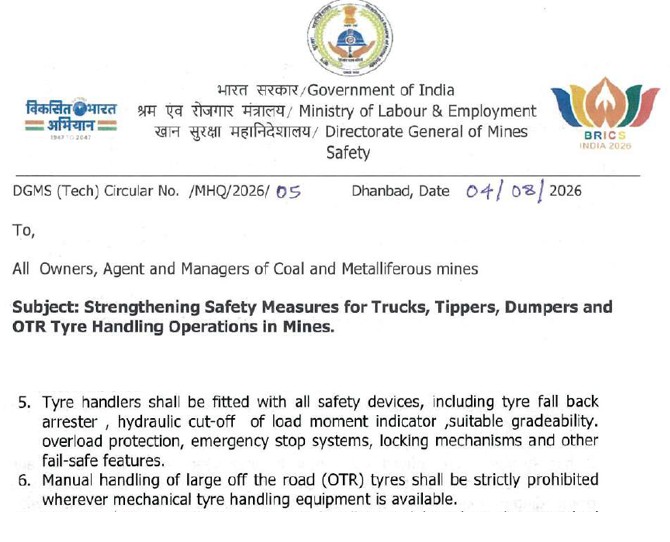
Only Related Points were listed in the DGMS Circular
1. Tyre Fall Back Arrestors
Tyre Fall Back Arrestor is a safety component fitted in the tyre handler attachment.
During the removal (or) Fitment of the tyres, The concern person performing the tyre change function should position / lock the tyre fall back arrestor parallel to the tyre surface & then only loosen / tighten the bolts in the rim
The tyre fall back arrestors will act as a mechanical guard. For instance, if the tyre is slipped the tyre fall back arrestor will protect the operator from tyre falling back on them thereby preventing the accident.
Is the above feature available in Vatsav Tyre Handler Attachment?
Yes , Tyre Fall Back Arrestor is a Standard Feature of Vatsav Tyre Handler Attachment for the new attachments being ordered by customer.
2. Hydraulic Cut Off
Hydraulic Pressure Cut off function ensure clamping pressure is at a optimal value depending on the tyre to be handled.
Is this Hydraulic Cut off function available in Vatsav Tyre Handler Attachment ?
Vatsav Tyre Handler attachment has a Safety Valve. Hydraulic Cut off is a inbuilt function of this safety valves. Excess Pressure will be automatically released without affecting the system clamping pressure already set based on Load.
2a. Load moment Indicator
Load moment Indicator (LMI) is a device normally fitted in prime movers which has extended boom. Normally this devices is fitted in Mobile Cranes / Telehandlers as the COG of the Load will Vary when the boom is moved away from the prime mover base structure (Body of the Machine). LMI will indicate the load acting on the prime mover at varied boom length in a crane or a similar equipment to monitor or avoid toppling of the body of the machine when the safe load is exceeded. Normally Alarms or Buzzers are used to alert the operator while exceeding the safe load
Is this Load Moment Indicator available in Vatsav make Tyre Handler Attachment ?
As read above LMI is a safety device used in Cranes / Telehandlers. Normally this will be part of the Crane / Telehandler OEM Supply.
Vatsav Tyre Handler attachments when fitted with telehandler will have this feature by default.
Vatsav Tyre Handler attachments when fitted with wheel loader. This feature is not applicable as there is no boom movement in wheel loader, However if required it will be provided as a additional feature with LMI.
3. Suitable Gradeability
Gradeability is the maximum uphill or downhill slope a Prime mover can safely climb or descend, usually expressed as a percentage (e.g., 15% or 20% grade)
What is Vatsav Tyre Handler Attachment – Take on the Gradeability ?
Vatsav Tyre Handlers are always integrated with Gradeablity Tested Prime movers.
4. Over load protection Systems.
Over Load Protection Systems ensures the Machine Components are not damaged during over load.
Do Vatsav Tyre Handler Attachments have Over Load Protection feature?
Yes, Vatsav Tyre Handler Attachment has Pressure Relief / Limiters in the safety valve which act quickly to suppress transient pressure spikes in the hydraulic circuits.
5. Emergency Stop Systems
As per DGMS Requirement Emergency Stop Switches are to be provided in the prime mover at the locations specified. These switches are often placed externally on the machine frame so ground personnel can shut it down if needed.
What is Vatsav Tyre Handler Attachment – Take on the Emergency Stop Sytems?
As read above, this switch is provided by the OEM of Prime mover, However the same can also be provided by Vatsav incase of non availability to ensure safety.
6. Locking Mechanism & Other safety Features.
It is Vital to have Locking Mechanism & Other other safety related features in tyre handler attachments like Self Locking . Load Holding features etc in a tyre handler attachment.
Does Vatsav Tyre Handler Attachment has the above features ?
Yes, Vatsav Tyre Handler Attachment has following features as described below.
- Load Holding Valve – By default the handlers supplied by Vatsav Engineering will have this safety device for all the functions
- Locking Mechanism – Unlike other manufactures Vatsav doesn't use hydraulic cylinders for gripper, Vatsav uses self locking grippers which will not allow slippage or movement of tyres after holding.
- Safety Camera – Vatsav Tyre Handler Attachment are integrated with camera with suitable IP & this ensures operators safety & ease of operation
- Enough Room for Tyre & Operator – Vatsav’s Patterned curved design ensures Safety of the operator by providing additional & safer space while performing the tyre change operation.
Industrial Automation
Special Purpose Machinery: Developing Equipment Around Industrial Requirements
5–6 min read | Vatsav Engineering Private Limited
Industrial manufacturing processes often have requirements that cannot be fully addressed by standard, off-the-shelf machinery. Different components, processes, operating conditions and production targets may require equipment designed specifically for the application.
What Is Special Purpose Machinery?
Special Purpose Machinery (SPM) is equipment developed to perform a defined industrial operation or sequence of operations. The machine is developed around the intended application and its requirements.
Why Requirement Understanding Matters
Every manufacturing process has its own requirements. Component size or geometry, production sequence, available floor space, material flow and integration with existing equipment can influence the machine design.
From Requirement to Machine
- Understand the requirement: identify the operation, component, sequence and constraints.
- Develop the concept: create an engineering concept around the requirement.
- Customer review: review the proposed concept before further development.
- Detailed engineering: develop the required mechanical and automation functions.
- Manufacturing and assembly: manufacture, assemble and integrate the equipment.
- Control and automation: incorporate appropriate control systems where required.
The Role of Automation
SPMs can combine mechanical systems with electrical and software controls. Depending on the application, automation can coordinate machine movements, component handling, operating sequences, sensors, actuators and operator controls.
Integration With Material Handling
A machine does not always operate independently. Components may need to be transferred between operations, so conveyors, material handling equipment, accumulation sections and turning mechanisms can form part of an integrated solution where required.
Vatsav Engineering's Automation Portfolio
- Special Purpose Machinery
- Conveyors
- Material Handling Equipment
- Workholding Devices
- Cutting Tools
Customized Control Systems
Depending on the application, a machine can incorporate PLCs, operator panels, electrical control cabinets, sensors and motor controls. Control software and machine sequence can be developed around the intended operation.
Conclusion
Special Purpose Machinery provides an approach for industrial processes that require equipment developed around a particular application. Starting with the requirement allows mechanical, material-handling and automation considerations to be addressed together.
Mining Equipment
Cable Reel Handlers for Mining Cable Handling Applications
4–5 min read | Vatsav Engineering Private Limited
Cable handling can be a demanding part of mining operations, particularly when laying and reeling long lengths of LT and HT cable. A dedicated cable reel handler can provide a mechanical solution for handling the reel and carrying out cable-laying operations.
Cable Reel Handler Overview

Vatsav Cable Reel Handler
What Is a Cable Reel Handler?
Vatsav Engineering's Cable Reel Handler is designed specifically for laying LT and HT cables, considering green-mining requirements in India.
Reducing Manual Effort
The attachment is designed to reduce manual effort while laying and reeling HT and LT cables.
Quick-Hitch Compatibility
The cable reel attachment can be used with a Quick Hitch like Vatsav's other attachments. Vatsav states that it was the first in the Indian mining equipment industry to successfully commission a cable reel handler with a quick hitch.
Key Functions
- Reeling – winding cable onto the reel.
- Unreeling – releasing cable from the reel.
- Laying – handling cable during installation.
Technical Specification
- Capacity: up to 600 metres cable
- Max. Cable Size: Ø80 mm cable
- Functions: Reeling / Unreeling / Laying of Cable
- Optional: Camera & Monitor
- Local content: 100% Made in India
Why Application-Specific Cable Handling Matters
Cable dimensions, length, laying requirements and the available prime mover influence the configuration. A dedicated attachment can be developed around the actual cable-handling requirement.
Conclusion
For mining operations involving long LT and HT cables, cable reel handling is an important material-handling requirement. Vatsav Engineering's Cable Reel Handler combines reeling, unreeling and laying functions with a detachable attachment approach and optional camera-and-monitor support.
Have an Engineering Requirement?
Talk to Vatsav Engineering about your mining, automation or material-handling application.
Contact Vatsav Engineering
